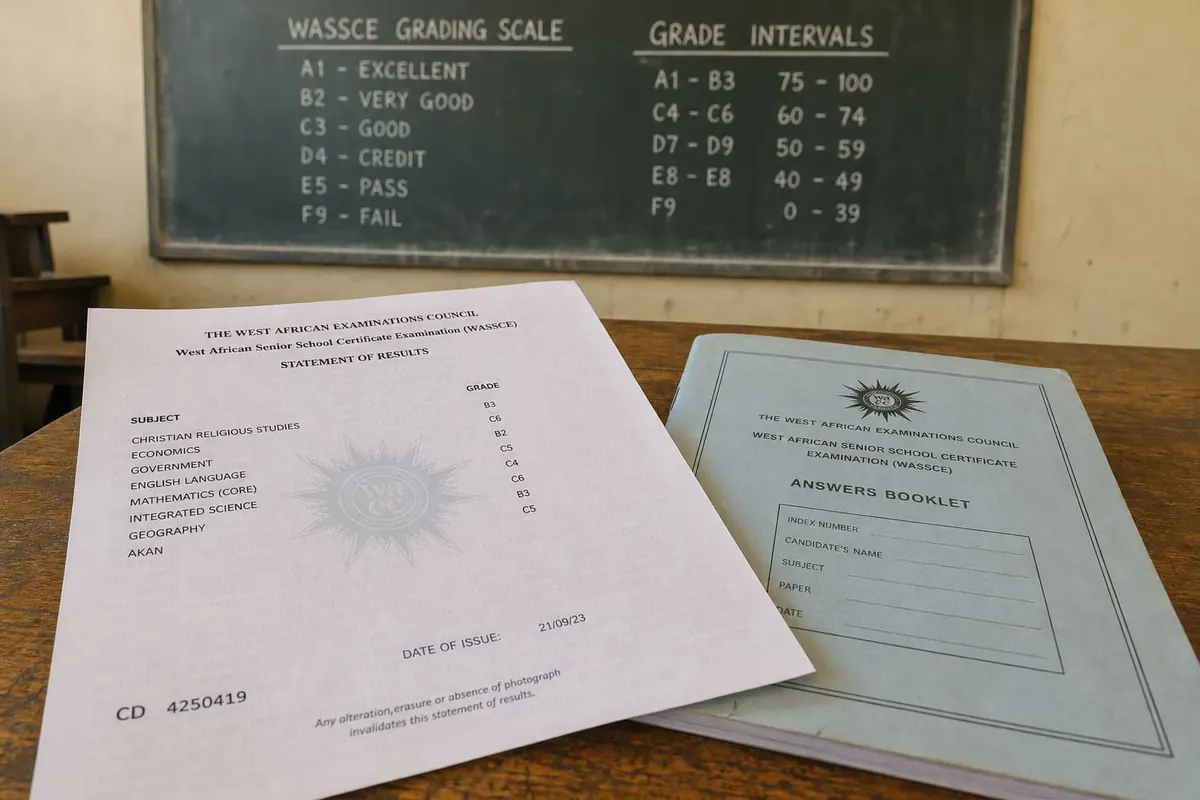
The WASSCE grading system in Ghana is how WAEC turns exam performance into letter grades and how tertiary schools turn those grades into aggregates for admission. Understanding A1–F9 and how aggregates are calculated saves you from applying for programmes you cannot enter — and from panic when a single grade looks “bad” in isolation.
The letter grades (core idea)
WASSCE results are reported with grades such as A1, B2, B3, C4, C5, C6, D7, E8, and F9. Broadly:
- A1–C6 are commonly treated as credit / pass bands for many tertiary entry rules (exact programme rules still win).
- D7–E8 are weaker passes that may or may not help for competitive programmes.
- F9 is a fail for that subject.
Always check the current WAEC / school brochure language for that year — terminology for “credit” and programme-specific subject requirements can be stricter than general chat.
How aggregates usually work for university entry
Public universities in Ghana often look at an aggregate built from your best relevant grades (commonly six subjects including core requirements, depending on the school and programme). Lower aggregates are better. A student with mostly A1/B2 grades will have a much stronger aggregate than someone with mostly C5/C6.
Subject combinations matter as much as the number. Engineering, medicine-related tracks, business, and education programmes often demand specific electives at credit level. An excellent aggregate with the wrong subjects still fails eligibility.
Core subjects vs electives
Most SHS students write core subjects (English, Mathematics, Integrated Science, Social Studies — exact set depends on programme) plus electives. When you check your WASSCE results, list cores and electives separately, then map them against the university programme page.
Practical examples (illustrative only)
Suppose two students both “passed.” Student A has A1/B2 across cores and strong science electives — competitive for many STEM programmes. Student B has C5/C6 across the board — may still enter some programmes or fee-paying tracks, but will struggle with ultra-selective cut-offs. Numbers change yearly; treat social media cut-off screenshots as rumours until the school publishes that cycle’s guidance.
Re-sits and Nov/Dec
If a critical subject is F9 or too weak for your target programme, many students plan a re-sit rather than forcing applications that will be rejected. Compare tuition and time cost of waiting one cycle versus accepting a less preferred programme now. Guidance counsellors and the WAEC calendar (not Instagram) set the real re-sit windows.
What employers and professional bodies look at
Some jobs and professional registrations also ask for WASSCE credits in English and Mathematics specifically. Keep certified copies or portal printouts safe long after SHS.
Common myths
- “C6 means you failed.” Not automatically — many programmes accept C6 as a credit pass. Competitive programmes may still prefer stronger grades.
- “Aggregate is the only thing.” Wrong subjects or missing a required elective can block you even with a good aggregate.
- “WhatsApp cut-offs are official.” Only trust the university admissions portal / brochure for that year.
Next steps after you understand your grades
- Write every subject and grade in a table.
- Shortlist programmes whose subject rules you meet.
- Budget for application vouchers across more than one school if needed.
- Follow the university application overview and verify fees on official sites.
FAQ
Is A1 the highest?
Yes — A1 is the top band in the usual WASSCE letter scale discussed for Ghana SHS leavers.
Do private universities use the same grades?
They read the same WASSCE grades but set their own entry policies and fees.
Where do I confirm cut-offs?
That year’s university admissions materials — not a blog post, including this one.
WASSCE grading is a map, not a verdict on your future. Learn how A1–F9 and aggregates interact with programme rules, then apply where you genuinely qualify — and verify every cut-off on the official portal for the admission year you are entering.
Disclaimer
Sengideons.com does not host any files on its servers. All point to content hosted on third-party websites. Sengideons.com does not accept responsibility for content hosted on third-party websites and does not have any involvement in the same.